Pain in the Back? The Pelvic Floor May Hold the Answer - Episode 38
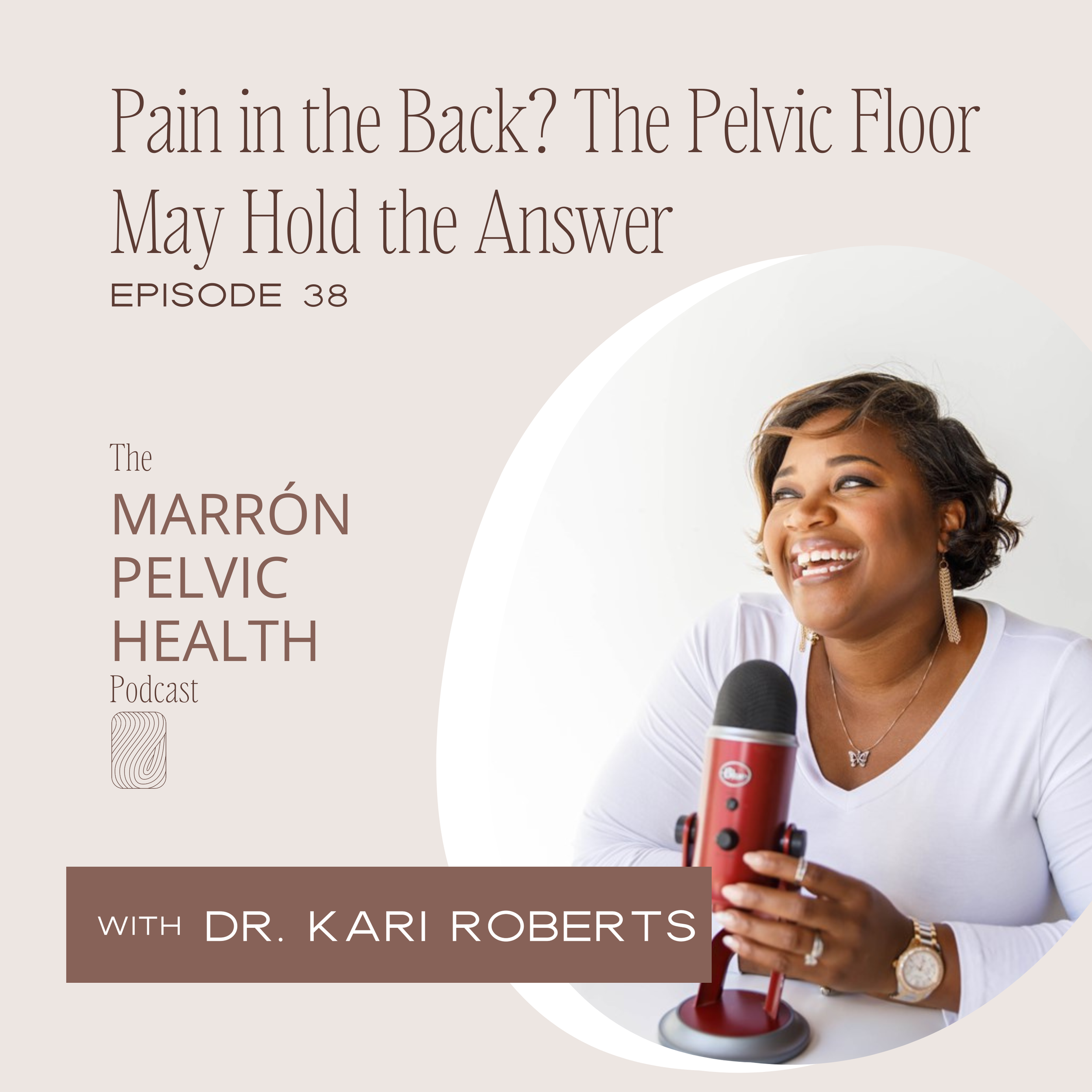
In this episode of the Marron Pelvic Health Podcast, Dr. Carrie Roberts explores the often overlooked relationship between low back pain and pelvic floor dysfunction. While many patients turn to physical therapy or pain clinics, pelvic health could be the underlying factor causing their discomfort. Dr. Roberts explains how the pelvic floor contributes to stability and support in the body, and how its dysfunction could lead to symptoms like low back pain, constipation, and bladder issues. Through patient stories, she illustrates the importance of incorporating pelvic physical therapy into traditional treatments to provide comprehensive care.
Book a call with Dr. Kari Roberts today.
-
Dr. Kari: Have you ever had low back pain that just wouldn't go or been referred to pelvic physical therapy for low back pain and wondered why?
If so, then stay tuned to this episode.
Dr. Kari: Welcome to the Marron Pelvic Health Podcast. Hi, I'm your host, Dr. Carrie Roberts. On this show, we will be discussing a variety of things regarding your pelvic health. These conversations will be a mix of education,
personal experiences, and a blend of tips you can apply to have a healthier pelvis.
The goal of this show is to normalize conversations around pelvic health and help women stop suffering in silence.
Dr. Kari: So let's get into this conversation about low back pain. And I brought my notes again. I'm so proud that I'm continuing to bring a little bit of forethought to these conversations.
So then that way you, you all can really get some good,
what's the word value out of the conversations that I'm having with you? And so today I wanted to talk about pelvic physical therapy and low back pain. And many people don't really think about pelvic physical therapy and low back pain.
And you can't really blame them because when you're having an issue with constipation, people don't really think about bladder. And when you're having sexual discomfort, people don't really think about the diaphragm either.
So even though the things are all connected,
we don't always naturally think about that.
And I wanted to talk about low back pain because so many people in this country, in this world are walking around with low back pain and so many people are going to physical therapy or personal training or pain management clinics, acupuncturists, all of these different practitioners to try to manage their low back pain or to try to feel better.
And a little bit of story time for you, many people, I don't know if they don't know, it's not a secret. But in the process of me growing this business and having some personal health challenges and sidebacks, side setbacks along the way,
I am working my business part time and I get steady income from a side a part time job and I work in a pain management clinic. And so many of those patients are coming in for low back pain.
They're coming in for low back pain because of just chronic pain. They might have had a work related incident or they might have had a car accident.
And many of these people have low back pain.
And before I became a pelvic physical therapist and took the extra training, I would have treated them the same. I would have gone through the same core stabilization,
range of motion,
generalized mobility work to try to help them get better. And we know a lot of times that works for a lot of people, and a lot of times it doesn't.
So then if that didn't work as a clinician, I would have referred them back to the.
The medical team. Something's going on medically. They need their pain managed that.
But now that I'm a pelvic health expert and I've been working in this space for several years, and I have treated so many patients with low back pain, I'm coming from a different perspective.
When people come to see me with pelvic physical therapy issues,
they're usually coming in with the bowel, the bladder, the constipation, the diastasis, recti. They're coming in with those things. And I'm asking them about low back pain, and then they're like, you know what?
I didn't really know that was something that could be helped. Whereas generally speaking, people will have low back pain, and then you might just kind of get stuck.
So why would someone get stuck? Well, there is a huge piece of treatment for low back pain that's getting overlooked and spoiler alert, it's pelvic physical therapy.
So let's go back a little bit and explain.
How does the pelvic floor even impact the low back?
Well, for starters, the pelvic floor has multiple functions. One of its functions is stability of the hip girdle, and the other one is support of the lower pelvic or the lower abdominal organs.
So when you think about that support,
you want those muscles in the connective tissue to give support to the ******,
the prostate, the bladder, the ******.
We want those structures to be supported well. We already know if something's not supported properly, something else is gonna kick.
Well, what's going to kick in? If your pelvic floor is not doing its job, then you might get some activity from your multifidus, your deep, low back muscles, your deeper abdominal muscles, other muscles might be trying to kick in to try to help for the weakness of the pelvic floor.
Something else where the pelvic floor is so integral with being something we should not overlook with low back pain, is that the pelvic floor also helps with stabilization and it stabilizes the hip girdle.
But when you think about stabilizing the hip girdle, we can't think about it just in isolation. We have to think about the hip girdle is just below the spinal cord.
You know, you've got your spine into your sacrum and your sacrum as a part of that hip girdle. So there we've got a literal connection between the pelvic floor or the pelvis and the spine.
So that's the reason why we really shouldn't neglect it. Because the pelvic floor is really key with giving that part of our body support, support and stability.
Now, let's think about this a little bit. What happens when things can go wrong? Well, if the pelvic floor is not functioning properly, then we can get dysfunction. And one of those dysfunctions is those organs are not supported properly, which I just talked about.
If the organs aren't supported properly, you can get an array of symptoms, right,
with bowel and bladder changes in pain and pressure and things like that. But then also you can get changes where other muscles are compensating. And most of those muscles tend to be lower back and abdominal muscles, which we think about as the core.
Right.
Something else that happens is if you are not stable,
right? If one of the functions for the pelvic floor is for it to help with stability of the pelvic girdle, if something's not stable,
then it's going to throw things off. So if you've got a hip joint, or, excuse me, a hip girdle that's not stable, it. It can have a direct impact with the hip girdle at the hip joint.
It can have a direct impact with your legs, with your.
It can go up or down the abdomen, the ribcage, all of that stuff.
Other common symptoms of low back pain that people don't generally think about the pelvic floor, but we probably should,
is if you're having issues with hip pain. Well, the hip joint attaches to the pelvis,
right? The lower back attaches to the pelvis. A lot of times people have low back pain and they have associated with SI joint pain or that side back hip pain that those are.
Those are the same structures that are part of the pelvic girdle. Those are the same structures that are part, the same muscles. Also between those two structures,
then we've got coccydynia. I'm going to get to a story with a patient. I'm going to be vague, but I'm going to get to a story about a patient I had with coccydynia.
And. And it's like no one's out coming.
But coccydynia is when you have coccyx or tailbone pain.
So that if you're going to a general practitioner or someone that's not thinking about the pelvis, they could automatically be lumping the coccyx with the spine, which, of course, it's the very tip of it, and think, okay, low back pain.
But the coccyx is so pivotal with your pelvic floor, because most of the pelvic floor muscles attached to the coccyx. So just like with the knee, if you have knee pain, we wouldn't just say, okay, just look at the quads.
We will want to also look at the hamstrings, because the hamstrings has a direct impact on the joint. Same thing is true with the coccyx. We want to. If you've got lower tailbone or coccyx pain, we want to look at those muscles that are directly attaching to it, because those could be an area,
a source of aggravation. But it could also drive your treatment technique as well.
Something else we think about with low back pain is radiating pain down the leg, right? A lot of people have heard of disc pain, herniated disc pain, pinched nerve, sciatica.
These symptoms that go down the back of the leg or the side or even wrap around to the front, we're thinking about as clinicians, we're thinking about dermatomes and myotomes and things like that.
But we can't just think about it all coming from the spine. Spine,
especially now that we've just talked, the spine is attached to the pelvic girdle, and the pelvic floor is the integral part of that connection.
So a lot of times when people are having those radiating symptoms and they're not getting better,
sometimes we can't just think about. As clinicians, we can't just think about piriformis and hamstrings and stretching, everything else. Sometimes we have to think about what's on the other side of the piriformis.
We've worked on everything out, but let's work in. And on the inside is your obturator internus and your pelvic floor muscles.
Okay,
so what happens at an evaluation? We do the evaluation just like any other therapist. We're gonna look at range of motion and strength and sensation and function. We're really going to look at the actual function of the pelvic floor.
When you go for. If you've had some sort of procedure or an incident and you have low back pain, a lot of times your physician or. Or practitioner will ask you, have you had any bowel or bladder changes and A lot of times they're thinking neurological, is this a sign of spinal cord injury or cauda equina type syndrome or something like that?
But having changes with bowel and bladder, hopefully if you listen to other episodes of mine, you learn having changes of your bowel and bladder habits could be also directly related to the function of the pelvic floor and those nerves might very well be intact.
So we want to make sure that we're looking at everything all together. If you've got low back pain and you've had changes at your bowel or bladder habits, or if you have low back pain and then that tailbone or that coccyx pain, or low back pain and pain with intercourse,
or low back pain and changes with your bowel or bladder frequency,
all of those things are signs that their pelvic floor muscles could be impacted just as much as your lower back muscles. So we really do not want to overlook that.
Just to do a little story time, number two, I wanted to talk to you about a patient that I saw at that pain management clinic who was rear ended on the interstate.
And she had very deep, low, low back pain and she had a series of injections that didn't seem to work. So they were thinking about maybe doing an ablation, which is when they go in and burn some of the nerves so that it can reduce your pain.
And she didn't want to do that. So we did. They recommended to pelvic physical, or excuse me, physical therapy as kind of a last ditch effort and a way to play the game with insurance companies so then the insurance company can pay for additional, more invasive procedure.
So when she comes in, of course I've got pain when I sit, I've got pain when I cough,
I've got low back pain, it's all the time. I've got pain when I roll around in bed. Classic low back pain stuff. But classic thing. Where is your low back pain?
Well, she pointed to the low back pain like most people do and I'm like, okay, when you have your pain, when you're sitting, where is it? And then she pointed really lower, closer to her, the crack of her bottom.
And then that's when I said, okay, have you had any changes with your bowel or bladder? And she said she did,
she did have changes with her bowel or bladder. She lost pretty much all control of her bowel or bladder. And she was walking around with a pad and had been for the several months that she was since she had had the car accident.
So immediately I'm thinking Pelvic physical therapy. But I'm not.
I'm not my space. I don't have all my tools. I don't have the time like I would want.
But I just, I said, okay, we're going to do two weeks of traditional therapy with my assistant because she's not a pelvic health therapist there either.
And then if that doesn't work, I'm going to flip you over to my schedule and I'm going to just start incorporating some techniques from pelvic physical therapy.
The two weeks of traditional physical therapy helped her feel stronger and feel more flexible and get her to be able to move better in life. But it didn't touch anything as far as her pain.
It didn't change how she felt when she was sitting, and it didn't change the bladder changes.
So I said, okay. So I incorporated some techniques. I couldn't do a full assessment with the way that everything was set up there, but we started incorporating some techniques specifically targeting her pelvic floor and specifically targeting getting that coccyx to get some more mobility in the muscles around it to start working better.
And it didn't take long. It took about five or six weeks to start noticing a pretty significant change.
Unfortunately, her insurance didn't allow her to come for all of the visits that she needed. But she did email me a few months later and tell me she was continuing doing what we worked on.
She was no longer having to wear a pad. She was just wearing a panty liner for just in case she wasn't having any accidents. She was able to get up and off the floor with her grandson.
She was able to be intimate with her husband without any difficulty. Again. And this is a woman that was in her late 40s, so some of these symptoms she was dealing with were not things that we would even consider normal with aging.
So I was so thankful to help her with that.
So she was a perfect person. That was labeled as low back pain, labeled as low back pain, that wasn't getting better with the regular treatment plans. And just by doing that slight pivot with the inter.
The inter.
Not the integrations. What's the word?
The interventions that I was able to use with my physical therapy knowledge, I was able to help her get over that hump and feel better.
So if you've got low back pain and you've gone to physical therapist a couple of times and it hasn't worked,
or you've got low back pain and you've got this little weird bowel or bladder thing going on, and you don't think they're related. They might very well be.
Or if you've got a nagging hip pain or you've got sciatica that won't go,
or pain when you're sitting, don't hesitate to reach out to a pelvic physical therapist. We might just have the tools that you need to help you get over your hump, just like I helped with my patient and help you feel better without having any major invasive procedures.
So that was my tidbit for this week. Come back next week with another episode all about pelvic physical therapy.
Dr. Kari: Thank you for listening to this episode of the Maroon Pelvic Health Podcast.
Dr. Kari: Please do me a favor and leave.
Dr. Kari: A review so that more people can find this content. And make sure you like and subscribe yourself so you never miss another episode.