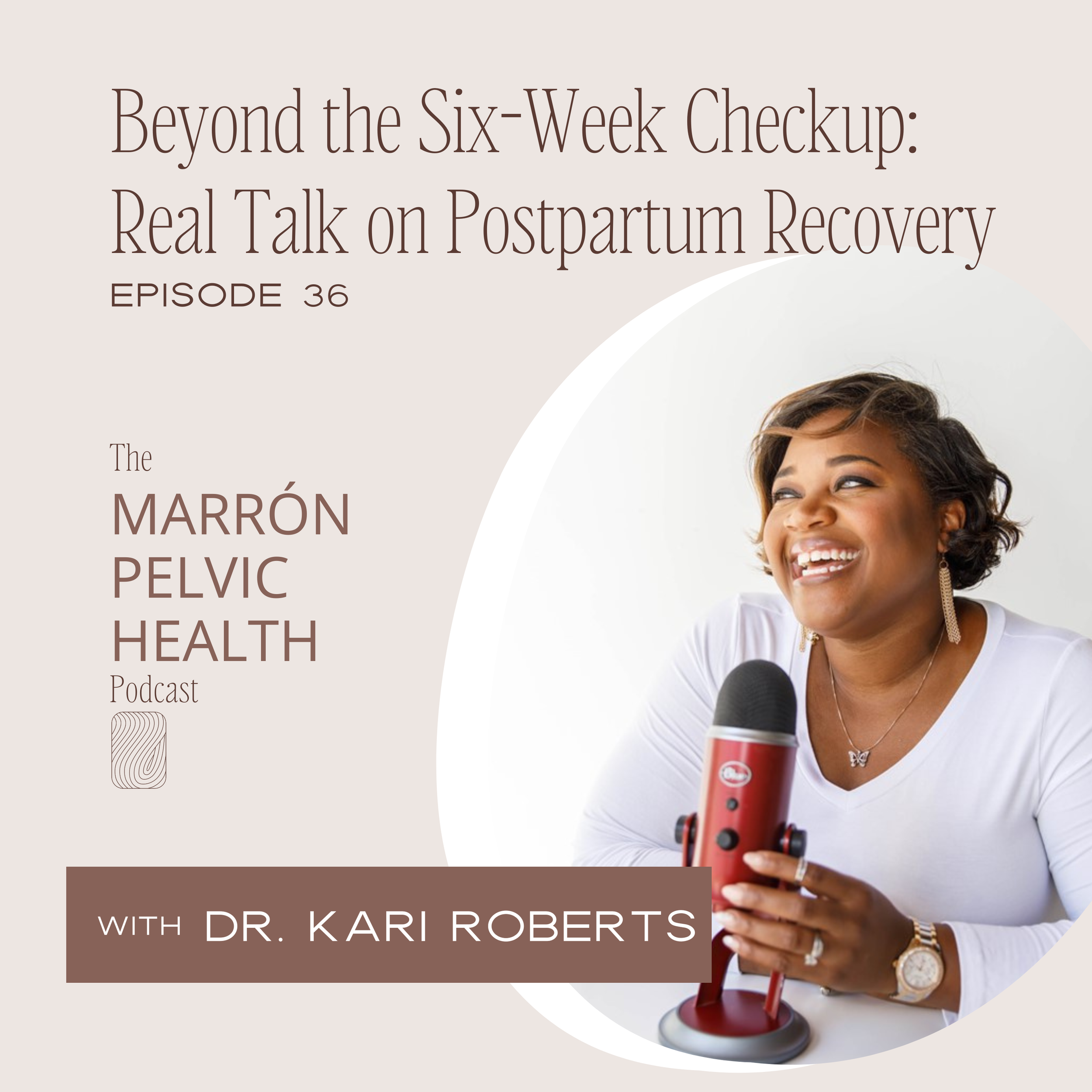
Beyond the Six-Week Checkup: Real Talk on Postpartum Recovery - Episode 36
In this episode, Dr. Kari Roberts delves into the often misunderstood realm of postpartum recovery. She highlights that while the standard six-week checkup may clear women for normal activity, many still face issues that go unnoticed. From muscle function to hormonal changes, various factors affect how a woman feels after giving birth. Dr. Roberts explains how pelvic physical therapy can address these issues, focusing on muscle strength, coordination, and emotional readiness. By shifting expectations away from rapid 'snapback' recovery, she advocates for a more realistic and supportive approach to postpartum health.
Book a call with Dr. Kari Roberts today.
-
Dr. Kari: Have you just had a baby and been told you've had your six week checkup and everything's good, but you just don't feel good and you wonder why?
If so, stay tuned to this podcast.
Welcome to the Marron Pelvic Health Podcast. Hi, I'm your host, Dr. Kari Roberts. On this show, we will be discussing a variety of things regarding your pelvic health. These conversations will be a mix of education,
personal experiences, and a blend of tips you can apply to have a healthier pelvis. The goal of this show is to normalize conversations around pelvic health and help women stop suffering in silence.
All right, so we're getting into this whole situation about are you back to normal? Are you good after six weeks? And the reason why I'm talking about this today is because I have been many clients that come to see me.
If they see me while they're still pregnant, then we don't have this conversation. But when I see people for the first time after they've given birth, a lot of times they would have gone for that six week OB checkup, gotten the clean bill of health,
everything's good to go and they don't feel like everything's good to go. Or there might be some things that our shift have shifted, like your comfort level with being intimate or your blood bladder function or your bowel function.
And all of those things could still be a little bit amiss.
So what, what are, what's really going on with the six week checkup?
Well, the first thing is when your physician is doing your checkup,
they are really looking at the tissues and making sure your tissues are healed. And I've said this on multiple podcasts. Just a couple of weeks ago, I just did a podcast.
It's not bad.
When you go to the physician and you get your clean bill of health, that's actually a good thing because that means that your systems are working properly and your tissues have healed and your tissues are healthy.
We want those tissues to be healthy. We want that blood flow to be working. We want the system to be doing what it needs to do. So that is good.
But a lot of times what physicians miss, which is where physical therapists come in, is they miss the integrity and the function of those muscles.
They don't. They're not looking into the strength of those pelvic muscles, the coordination of those pelvic, pelvic muscles.
If those muscles have extra tension,
are they stabilizing like they need to? And your readiness to even be intimate, which is not a muscular thing, that's more of a nervous system and an emotional thing. But those four, five things that I just listed, your strength, your coordination,
the muscle tension, the stability and your comfortability,
if that's a word for being intimate, those things are not taking into account when you do go for that six week checkup.
When we think about a postpartum body,
we really need to take into account is,
excuse me, what are you recovering from? Are you recovering from a vaginal delivery? Are you recovering from a cesarean delivery? Were those deliveries scheduled and planned and went off without a hitch?
Or was there an urgency about the situation? Was there,
was the labor prolonged? Was it really short? Was there tearing involved?
All of those things.
We've got to kind of weigh that option when we're looking at how ready you are to be back, quote, unquote, to normal.
Something else that a postpartum body is recovering from is the hormonal shifts. Those hormones are definitely going through an adjustment.
Some of those hormones are added and higher when you're pregnant. And then when you give birth, those hormones can drop and your body has to adjust to that new that, that new normal that change your body after you've given birth,
usually 9 times out of 10 is dealing with sleep deprivation. Now your body is recovering, but you're taking care of a little one.
Did your body have excessive stretching and does it need to heal from that?
I mentioned it earlier, but your nervous system is adjusted, right? You're not the same. You, you've given birth, you're responsible for a new life. The those hormones could have shifted, which can affect your nervous system, your activity level, your worry level, your readiness to desire to do things like exercise and walk and be intimate.
All of those things have shifted. And maybe you don't feel comfortable with that. That can also impact your nervous system and how you identify as a woman,
as a mother now or a mother of multiples if that's the case, the emotional stress that comes with those responsibilities,
all of these things can be changing during postpartum phase. Now, when I'm saying postpartum, for the sake of this conversation,
I'm really looking at like 6 to 12, 6 to 18 weeks postpartum. But clinically,
a postpartum body to me is a postpartum body forever. You are post being pregnant, you are post giving birth.
Regardless of how old your child is, your body is postpartum.
There are a lot of things that happen in the postpartum body and we normalize them, but they may not be ideal or they may not be things that we want to be okay with, to accept some of those things are leaking.
Now, this is all after six weeks because you've given birth to your baby. If you've had a vaginal delivery, hopefully by six weeks, things during a vaginal delivery, things stretch and it takes about four to six weeks for things to kind of recoil back to where they're supposed to be.
If you've given birth with C section, then six weeks is usually about the benchmark where those tissues have healed and things that would have shifted post surgery should have gone back to normal.
So things that are not normal but are very common or things that we shouldn't accept that we are taught by society that we should accept that we shouldn't are after that six week point are when we've got coughing,
excuse me, leakage with coughing or lifting or moving,
pain with intimacy with, you know, vaginal penetration,
pelvic pressure and pelvic heaviness,
back pain, hip pain,
pelvic pain,
core weakness, or if you're lifting up out of bed or you're rolling up,
you notice like a coning or doming in your abdomen. Those are things that sometimes are, we're taught, oh, that's normal after you've given birth, then it's not things that definitely can be addressed and then just overall feeling like you don't connect with your body or you connect with your body a different way.
So those things are happen frequently, but these are things that we do not have to accept.
So these are things that we shouldn't have accept. So that's where pelvic PT enters. These are some things that pelvic PT can do to help the postpartum body recover or go through that phase.
One of them is we're definitely going to assess and look at the integrity of those pelvic floor and hip girdle muscles. We're going to look and see is the strength there?
Do we need to have strengthening the tension?
Is there too much tension? Is there too little tension? What can we do to normalize the tension?
The coordination aspect, Are these muscles turning on and off like they're supposed to and are they playing with their partners? Well, sometimes when one muscle turns on, another one should be coming on.
Sometimes when one muscle is turning on, another one should be turning off. Is that coordination doing? Is are these muscles coordinated? And if not, what can we do to help improve that coordination?
And then the stability aspect, are there balance activities and stretches and strengthening things that we can do to help improve the stability of your pelvic floor and your Pelvic girdle, and then that readiness to be intimate, readiness for penetration in the vaginal area.
Now we're looking at. It does tip into a little bit more of the nervous system. But what kind of stresses and tools and exercises can we do to prep the area so that you can receive penetration in the ******?
But then also, what are some exercises and things we can do to help regulate your nervous system, to help manage some of the concern or worry that you may have?
All of those things we can definitely address here in pelvic physical therapy.
Now,
if you are post surgery, we can do tons of things to manage your scar, promote scar healing, help improve your scar mobility. If that's an issue,
that's whether you've had a C section, if you've torn in your *****, if you've had an episiotomy. All of those things weren't scars. And we can do things to help normalize the integrity of those scars, improve the mobility and the elasticity of those scars,
and reduce the risk of getting adhesions.
Next is when we're thinking about coordination in those muscles. We want to make sure that we're going to normalize your breathing technique. Breathing is huge with pelvic physical therapy, because it usually can help us be the starting point for so many things.
Next, we're going to make sure that your pressure is being managed properly. If your pressure is not being managed properly,
that can present as far as having the ab separation or diastasis recti or dra, some people call it, or that pressure management could result in prolapse in your pelvic area, or that lack of pressure control could present as hemorrhoids.
So all of those things can be results of pressure issues.
So we're going to make sure that that pressure is normalized in pelvic physical therapy.
Something else we're going to do is just help you improve your posture. You're taking care of an infant that's depending on you for its life. You're probably bending over a lot.
You're probably hunched over a lot, reaching into the carriage or the bassinet,
breastfeeding, bottle feeding, holding that baby. There's a lot of forward movement. So we want to make sure that we are optimizing your posture. It's not just about standing up straight.
It's about,
are those postural muscles strong enough to hold you in different positions without letting your posture go out the window?
And then next, we're gonna help regulate the nervous system. I think I said that. But just to make sure, you know, oh, I said that as far as getting ready for intimacy.
But we wanna make sure we're regulating the nervous system in a general basis because the pelvic floor is so closely related to the nervous system. When our nervous system is a little bit overactive or even a little underactive, it can throw off the integrity of how the pelvic floor is performing.
So those are all the things that pelvic physical therapy is going to assess and normalize and optimize for you. And then specifically, what can pelvic physical therapy help with? If this is not your first time listening to this episode?
This is probably not new to hear from me, but pelvic physical therapy can help with your bladder control, your bowel control, if you're dealing with constipation or if you're dealing with increased bladder,
urinary urgency, urinary frequency leakage. Pelvic physical therapy is great to help with that,
managing your pain with your intimacy. We can definitely help with improving your core, as far as your range of motion, your mobility,
your coordination,
your strength.
All of that we can definitely help with with pelvic physical therapy.
And a lot of times when we normalize those things, your bowel and bladder control, your strength, your coordination,
your mobility,
then the side effect is people tend to feel better, your confidence is improved. Your, you start to be more comfortable with getting out and moving again,
getting together with loved ones, maybe going out with friends,
dancing, exercising, walking with your baby.
Once you start to get that improvement and you feel more like yourself, you start to want to do more things that make you feel like yourself, which helps you improve your confidence.
So it's a nice, good, positive feedback loop that you get in now when you're growing your baby. It took nine months, nine and a half months to grow your baby.
I want to just talk a little bit about snapback culture.
There are, there's a lot of talk about it. Not as much as it was during the pandemic, but, you know, I am back to my size, whatever. I'm three weeks post op and I'm doing this.
Or look how good I look in my, in my outfit, or look how good I look with all my makeup on and on my Instagram. And I want to kind of silence the snapback culture.
It took nine months for your body to grow a human.
Let's not expect that your body's gonna snap back in a couple of weeks.
So it took several months to get there. It might take several months to get back.
Now let's layer on let's say you had a little bit of bladder issues, you had a little frequency urgency before the certain, before the pregnancy. Or let's say your core was already a little bit messed up or you had improper mechanics before the baby.
Throw on nine months of it going through its thing to grow your baby,
so your recovery might be longer. Because we are not only recovering from what you had before you got pregnant, but now we're recovering your pregnant body as well.
So it's gonna take time.
We're looking at several months to recover from having a baby and not several weeks.
And your progress, it's not a straight line. It's more like a roller coaster. It's gonna be two steps forward, one step back, three steps forward, a half a step back, one.
One step forward, two steps back. It's gonna be up and down and up and down. Now, when we take a step back and we look at it,
generally speaking, it's gonna be an upward trend. But don't be discouraged. If you're going through your process of recovering from having a baby and you feel like you're doing great and then it feels like you're, you're going back, that is normal.
That is part of the recovery. Because your progress is not gonna be linear.
Side note, your progress with anything is not gonna be linear. Whether it's physical therapy, exercising, any, eating well,
drinking more water,
sleeping more, minding your business,
anything we're usually working on as women, it usually does not improve on a straight line. It usually has some bumps in the road. So we wanna be mindful of that and expect the bumps in the road after you've had a baby as well.
So I hope that this little discussion helps you see,
main thing, you do not have to deal with these changes. You do not have to accept these changes after you've had a baby. And I don't care if your baby is 6 weeks old old or 36 years old, you do not have to deal with this any longer.
There is help for you.
You can find support in your community. You can find a local pelvic physical therapist. I can be your pelvic physical therapy therapist. Reach out. You do not have to deal with these things alone.
There's also other therapists out there if you need mental health therapy, or if you need nutritionists to help you get your food on board, or a coach. There are so many services out there right now for women so that you can recover from the baby that you gave birth to.
Your body is not failing you. Your body is just a little different Your body has gone through a change, and you need to just learn how to deal with that new change and learn how to help the body recover.
But I don't want you to feel like if something is hanging on more than six or eight weeks,
that it's just your new normal. It does not have to be your new normal. It can be your new normal temporarily, but it doesn't have to be your new normal forever.
So just as an overview, when should you seek out pelvic physical therapy? I say you should seek out a pelvic physical therapist as soon as you find out that you're pregnant, or at least within the first.
The end of the first trimester. But if that ship has sailed,
reach out. If those symptoms are lingering on more than about six or eight weeks.
If you're going to be starting a new exercise routine,
then you might want to seek a pelvic physical therapist to make sure you're not hurting yourselves and doing more harm than good.
If you feel like everything is just a little bit off, maybe it's not blaring, but your bladder and bowels have changed a little bit,
you might be a little bit more constipated, your hips don't feel quite right, you feel like a little weaker than you did before.
And then just generally speaking, if you are just unsure of yourself and you just want to work with an expert to make sure that you don't do the wrong thing,
there is no harm in seeking out a pelvic physical therapist. We're never gonna hold onto you too long. If you come in, you get your assessment, and it's like, you know what, your body's doing pretty good.
You don't have to worry. I do those visits all the time. Sometimes it's literally, you come in, you have a question, is everything okay? We go through it in one or two visits, and then you're on your way.
Then if there's. You come in and there's some things that aren't quite right, then I might need to see you for a while. But just because you're going to pelvic physical therapy does not mean you're signing up for pelvic physical therapy forever.
So I just wanted to share that with you,
give you some benchmarks of when to know when to get help. I feel like I'm rambling at this point, but mainly if those changes last more than six to eight weeks, if you're thinking about jumping into something new, or if, generally speaking, you just are unsure or want some professional guidance,
don't hesitate to reach out to a pelvic physical therapist.
Thank you for listening and I can't wait to join your earbuds in the next episode next week.
Thank you for listening to this episode of the Marron Pelvic Health Podcast.
Please do me a favor and leave a review so that more people can find this content.
And make sure you like and subscribe yourself so you never miss another episode.
Your episode
00:00/17:47
Learn more aboutwhat to put here.
In this episode, Dr. Kari Roberts delves into the often misunderstood realm of postpartum recovery. She highlights that while the standard six-week checkup may clear women for normal activity, many still face issues that go unnoticed. From muscle function to hormonal changes, various factors affect how a woman feels after giving birth. Dr. Roberts explains how pelvic physical therapy can address these issues, focusing on muscle strength, coordination, and emotional readiness. By shifting expectations away from rapid 'snapback' recovery, she advocates for a more realistic and supportive approach to postpartum health.
Book a call with Dr. Kari Roberts today.
Apple Podcasts and Spotify only allow hyperlinks and (un)ordered lists.
Generate title