From Interstitial Cystitis to Bladder Pain Syndrome - Episode 35
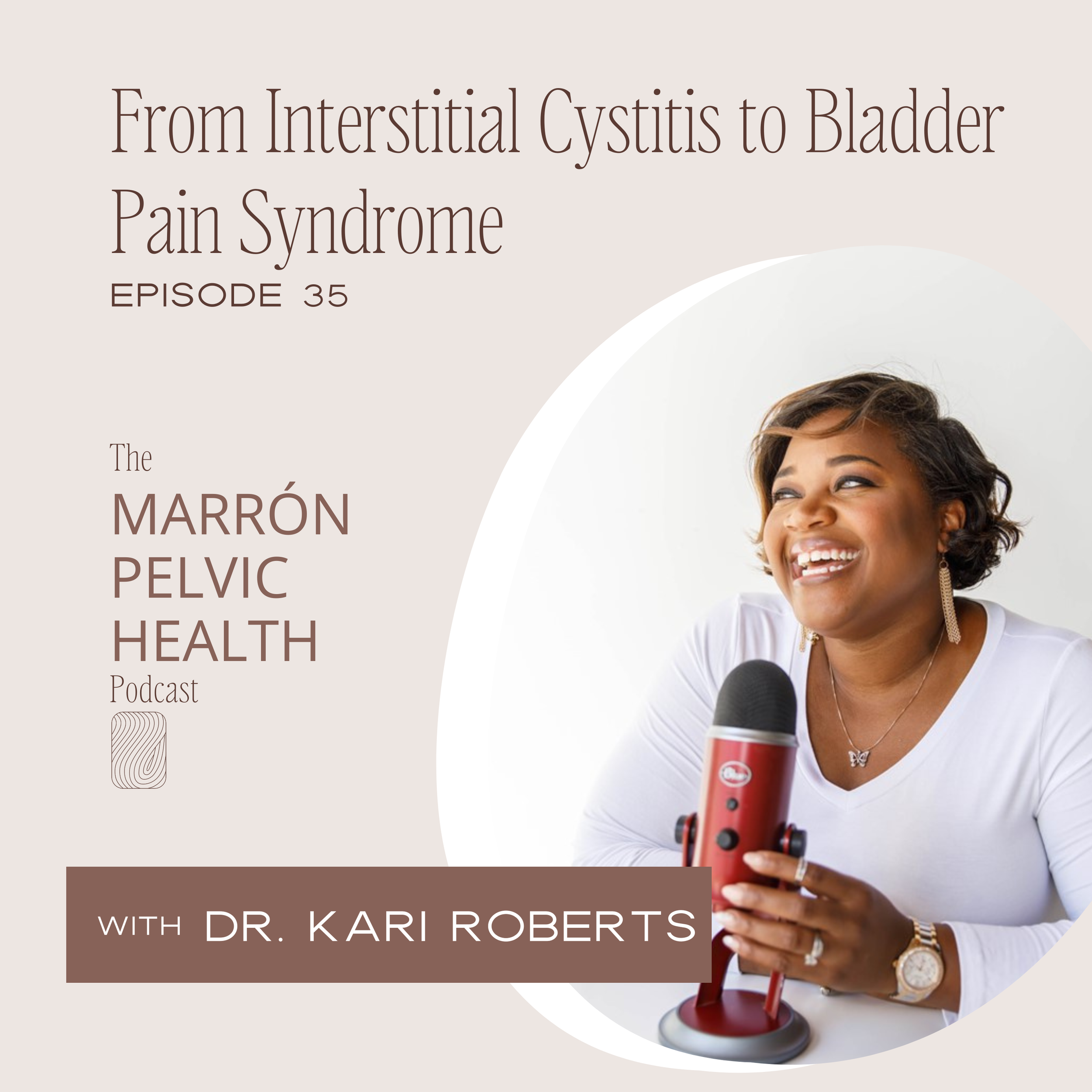
In this episode of the Marrón Pelvic Health Podcast, Dr. Kari Roberts sheds light on chronic bladder pain syndrome, previously known as interstitial cystitis. The episode delves into the symptoms associated with this condition, such as frequent urination and urgency, and explains potential causes. Dr. Kari emphasizes the role of pelvic physical therapy in managing these symptoms by reducing pelvic floor tension, retraining the bladder, and improving breathing techniques. Listeners are encouraged to track their symptoms, identify triggers, and explore the educational resources and interventions offered by pelvic physical therapists.
Check out Episode 6 - 4 Steps to Manage Urge Incontinence
Book a call with Dr. Kari Roberts today.
-
Dr. Kari: Have you been told that your bladder pain is normal? Just UTIs or something you need to live with?
If so, this episode is for you because chronic bladder pain syndrome is real and there's hope for you.
Welcome to the Marone Pelvic Health Podcast. Hi, I'm your host, Dr. Carrie Roberts. On this show, we will be discussing a variety of things regarding your pelvic health. These conversations will be a mix of education,
personal experiences, and a blend of tips you can apply to have a healthier pelvis. The goal of this show is to normalize conversations around pelvic health and help women stop suffering in silence.
I want to get into this whole situation that we know called chronic pain syndrome.
Excuse me? Chronic bladder pain syndrome.
Now,
the old term of it used to be called interstitial cystitis. So we're going to go down memory lane for just a little bit. We're going to talk about what it is,
then we're going to talk about the causes of it, how pelvic physical therapy can help and what your next steps are.
So let's go back in time a little bit. It used to be called interstitial cystitis. Now, cyst, anytime you hear that word cyst, it usually is the medical term for the bladder.
So interstitial cystitis is actually when there's a clinical chronic or not even chronic, but there's some irritation to the bladder lining. That's basically what. What interstitial cystitis is.
They have since moved away from this terminology, or the medical system is moving away from this terminology because they're finding people have these cluster of symptoms and their bladder lining is fine.
So it's now called bladder pain syndrome. Now, fun fact, a syndrome. I had to. I wrote my notes down. Where are they?
A syndrome is a group of symptoms without a single cause that's not fully understood, but it follows a particular pattern.
That's pretty much what bladder pain syndrome is.
Now, what can cause or what does it look like? Of course there's pelvic pain. It's in the name, right? But there's other things that are associated with this pelvic pain.
We have frequent urination.
That could be something. Then there's also urgency. The urgency. The difference between frequency and urgency is frequency is the amount of times you have to void or the amount of times you have to empty your bladder.
Whereas urgency is how strong that urge or how strong that signal is that you have to empty your bladder just in case. Peeing, for example. There's no urge. Right. There's nothing in your body saying, I have to go pee.
You're just doing it just in case. Cause you're going on a road trip or you're going up shopping or whatever. Whereas that strong urgency is like you're running to the bathroom.
You can barely pull your pants down and sit on the toilet. Cause the urgency is that strong, it feels like you're about to explode. So I hope that makes a difference.
Some people have that urge where they feel like they have to explode, but they might only empty their bladder every couple of hours, so the frequency is normal. Or some people might have a normal urge like, oh, I can get up and go to the bathroom.
But they feel like this is happening more than every two hours. So every 30 minutes, every 45 minutes, every hour. That's where the increased frequency comes in.
Something else that's common with this syndrome is when people.
When it's time to sit down and go to the bathroom, there's not much like you're like, I feel like I was gonna explode. And that was just a little tinkle.
Something else is when you feel pressure. And this pressure could be down in the *****. It could be down in the lower abdomen.
And then you can also have increased pain ***** or vaginal pain with intercourse,
or you could have increased pain with your cycle.
And just like other pains, you can have pain that radiates. So it might feel like it's starting in the pelvic region, but it can radiate around to the side, it can radiate down your thigh, it can radiate to your back.
That is all common with this.
And, oh, yeah. And I said you can have increased pain with your period.
Now, what are some of the causes of bladder pain syndrome? Well, some of the causes are obviously if you've got the cyst or the irritation in the bladder lining,
then that's a cause. Right? Your bladder.
Your bladder lining has. The integrity of it is diminished.
Now, I will say most people that were diagnosed with interstitial cystitis at one time. Don't quote me, but just numbers that I learned a few years ago when I was in pelvic health school was about 10% of those that were diagnosed with interstitial cystitis actually had those bladder ulcers,
which means 90% of people were having the same cluster. Cluster of symptoms without the ulcers. Hence why they changed the name. But that is something that is found with a cystoscope or a scope that looks into your bladder.
Something else that can cause this is if you have your, your pelvic floor tension is really tight.
If you've got a lot of tension through those muscles, then that could lead to this.
If you are just have some bladder sensitivities, so maybe there's no ulcers there, but you've got some bladder sensitivities that can cause it, then you've got your regular degular culprits, you've got your inflammation, you've got your stress,
you have your history of trauma.
All of those things can impact it. And of course, go ahead and throw some changes with the hormones. Yes, all of those things can impact it. So just as a review,
tension in your pelvic floor, those muscles that are too tight or they're overworking,
you have bladder sensitivities.
If you have a lot of stress in your body,
if you have inflammation in the area,
if you've got stress or history of trauma as well as hormonal changes can all impact us. And something else that I forgot to mention is that if you are just a person that is naturally, maybe you don't have anxiety around something specific, but if you're a naturally revved up kind of anxious person,
we usually say that your nervous system is a little bit upregulated or it's kind of working a little bit overdrive, then those people can have issues with these symptoms as well.
Now, you can have more than one culprit because remember, it's a cluster of symptoms. So you can have a cluster of causes too. And just like anything else, if you've got a cause, then we need to do something to reduce that cause or to,
yeah, reduce it, which we'll get into in a second.
Now, what can trigger a flare or what can trigger the pain in your bladder or in the pelvic region?
Acidic things. If you consume acidic food, foods, so think your, your coffees, your fizzy drinks, even if it's water, any kind of fizz can irritate the bladder lining.
Alcohol can do this. Citrus can do this. Now remember, that is really going to be in line with if you have the ulcers in your bladder. But they've also found this can be the case even if you don't have the ulcers in your bladder.
Something else is just generalized stress can make everything go up.
If you have constipation, bouts of constipation, or chronic constipation, because the space in the pelvic region is so small, if you've got stool building up on one side, the bladder can't stretch like it needs to and it can cause you to have some of these symptoms.
And then of course, if you are having increased pain when you're having intercourse or when you're on your cycle, then obviously a trigger can be when you're on your cycle and when you're having intercourse.
So the next thing is, what can pelvic physical therapy do to help you with this chronic bladder pain syndrome?
I hope you're hearing a trend in this conversation.
So if it's anything muscular, muscular related, pts are always going to be your first option. So if you've got those pelvic floor muscles that are over recruited or they're working too hard or they're too tight, these are all things that we are specialized to deal with to help reduce the tension,
help those muscles get back coordinated,
strengthen what is weak, relax what's overworking, that's all what pelvic physical therapy is great about.
Something else we can do is lots of education.
We can educate you on how to make some change. I'm trying not to jump ahead so we're going to actually put education to the back of us.
Next one, we can teach you how to retrain your bladder. I think that's pretty cool. The bladder is actually very trainable. Okay, I have episode number six which says four steps to manage urge incontinence.
And I talk about how training the bladder is like training a puppy. So you gotta go back and listen to that. But anyways, the bladder is very easy to train.
So we can teach you how to do that. In pelvic physical therapy we also can help you improve your breathing. Improving your breathing helps your body process stress. It helps those muscles coordinate and work well together.
Also helps those muscles go through great range of motion and we can help reduce. So remember when I was saying if you just kind of have a nervous system that's a little bit upregulated, we can teach you tons of things to down regulate your nervous system so that your body compresses that stress so everything's not so tight and rigid and so easily susceptible to the day,
the stresses of life.
Now with all of those things put together, you can see how pelvic physical therapy, we are a wealth of knowledge for education because we can educate you on how to manage your stress.
We can educate you on how to get those muscles to work well. We can educate you on what things to avoid and to stay away from as far as triggers and whatnot.
And we also can educate you with if there's any tools that need to be used so if you need a dilator or a vaginal wand or things like that, we can teach you if you need them, and then we can teach you how to use them.
Something else pelvic physical therapists are kind of set apart from the others is we are specifically trained on how to do internal work on those internal pelvic floor muscles. And so again, if those muscles are working too much, we can help reduce them.
If they're not working enough, we can help them to get on board. If they're too tight, we can help them relax. So those are great things that we can do through our internal approaches.
Something else we can do is we can teach you external approaches. If you don't need internal, or if internal is not your jam, we can still, we still have a bunch of tools we can do with external.
And again, like I said, if you need any other tool that needs to be used, we can educate you on that. So tons and tons and tons of education can be provided for you through pelvic physical therapy.
If you do have bladder pain syndrome now, what can you do? Now, if you're dealing with these symptoms well, you can tighten up on your breathing because proper breathing is key.
Something else that you can do is you can start tracking your symptoms and seeing what are your triggers, because everybody doesn't have the same triggers. I'll say I have interstitial cystitis and a lot of the things I was told to avoid doing just didn't apply to me and my body.
So what you could do, instead of taking away everything and slowly adding things in, which is the approach I did. What you could do is just simply track your symptoms to get an idea of what your triggers are.
And maybe there are some behavioral modifications you can do without having to seek medical attention.
Also, staying properly hydrated is key.
Sometimes you can be have a flare if you're under hydrated or over hydrated. But kind of just watching that is a very helpful tool to help you. And if you don't really know,
let's say, are you breathing correctly? If you don't know, or if you just want to get a professional's opinion, then just get help, Go to see your physician or better yet,
contact a pelvic physical. Physical.
I keep saying physical floor. It's physical.
Pelvic floor, physical therapist. Contact the pelvic floor physical therapist and see if one of us can help you. Now, I am located in the Marietta area outside of Atlanta, Georgia.
However, I do see patients both in house and virtually, and I would love the opportunity to help you. So if you think you're dealing with some of these bladder pain syndrome issues and it's sounding like you or someone you know,
first have them listen to this episode. Hopefully it will be helpful. Try some of those tips now as far as your breathing techniques, tracking your symptoms, and then if needed, reach out so that me or someone else that's trained in this can help you.
And I look forward to chatting with you next week with another episode.
Thank you for listening to this episode of the Marron Pelvic Health Podcast.
Please do me a favor and leave a review so that more people can find this content.
And make sure you like and subscribe yourself so you never miss another episode.