Leaking During Pregnancy: What's Normal & What Isn't
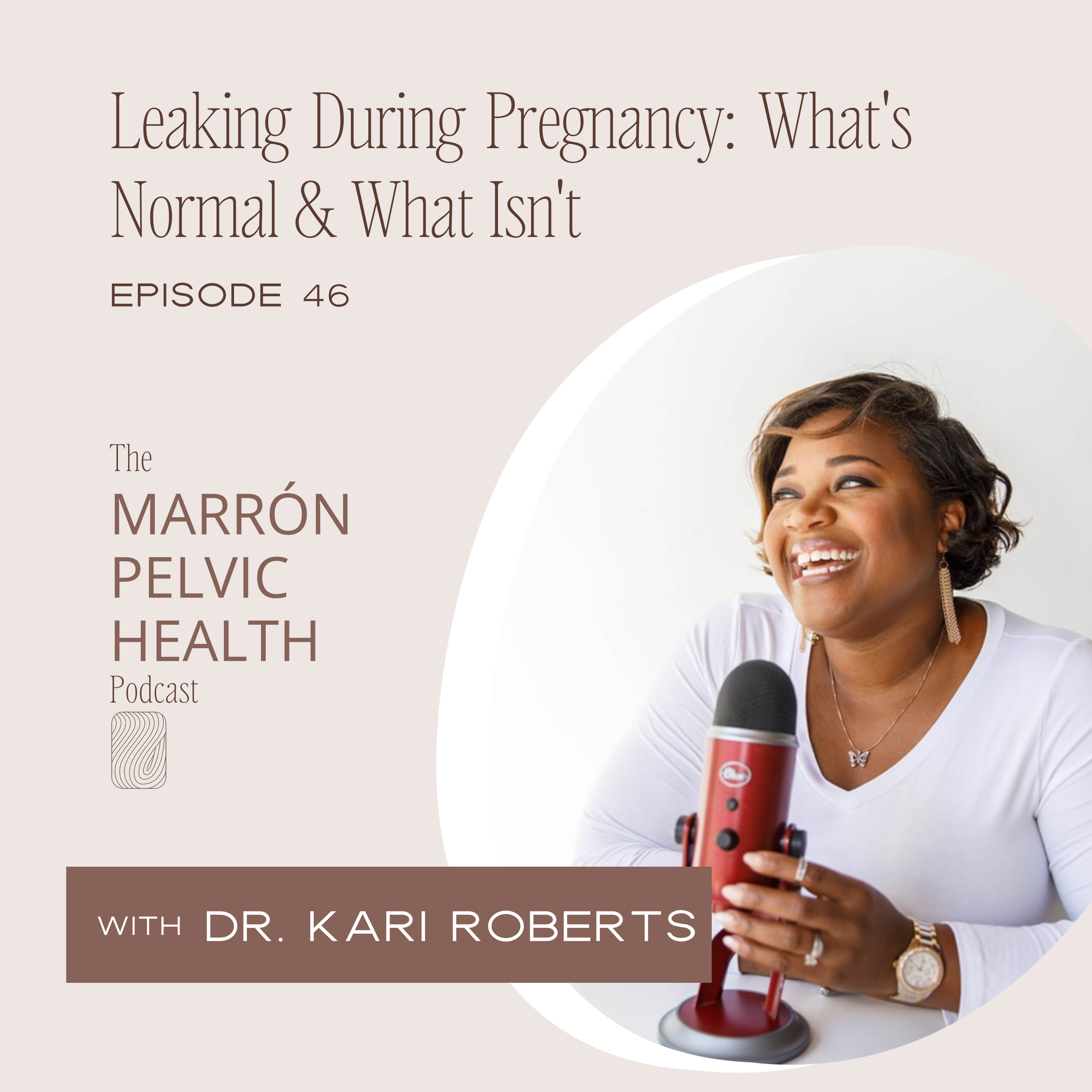
In this episode of the Marron Pelvic Health Podcast, host Dr. Kari Roberts dives into the common experience of leaking during pregnancy and explains what’s considered normal versus what may signal pelvic floor dysfunction. The podcast explores why bladder leaks can happen throughout pregnancy, how pressure changes impact the pelvic floor, and the signs that indicate it’s time to seek support. Dr. Kari highlights the benefits of pelvic physical therapy during pregnancy, sharing how targeted exercises, breathing strategies, and body awareness can help women feel stronger, more confident, and better prepared for delivery. The episode offers valuable insight for expectant mothers looking to stay proactive and supported throughout pregnancy.
Book a call with Dr. Kari Roberts today.
-
Dr. Kari: Are you pregnant and have noticed some changes with your bowel and bladder habits and wondered what is normal? If you have, then stay tuned to this episode.
Dr. Kari: Welcome to the Marone Pelvic Health Podcast. Hi, I'm your host, Dr. Carrie Roberts. On this show, we will be discussing a variety of things regarding your pelvic health. These conversations will be a mix of education,
personal experiences, and a blend of tips you can apply to have a healthier pelvis.
The goal of this show is to normalize conversations around pelvic health and help women stop suffering in silence.
Dr. Kari: So today I want to talk about leakage during pregnancy. What's normal, what's not normal, what you should kind of suck it up and deal and when you should seek help.
So first, let's talk about the different types of leakage you Usually we say leakage, but in the medical or in the healthcare world, we do call it incontinence. So whenever you are losing urine when you don't want to, even if it's just a little teeny tinkle, that's considered a form of incontinence.
And there are three different types of incontinence. I have episodes way back in the beginning that I kind of go through. But if you haven't listened to those, just as a quick refresh, one of them is stress incontinence, which basically means when your core system,
which includes the midsection between your rib cage and your pelvic floor, everything in the middle, that's kind of that core intra abdominal area,
and when that system has a lot of force on it and the pressure is not managed properly, then you can have stress incontinence. So how does that present that looks like leakage when you cough or sneeze or laugh or jump or lift up something heavy or exert yourself in a weird way and you have a little leakage or even a lot of leakage,
that is stress incontinence.
That system has been stressed and you leak a little urine.
The other form of incontinence is called urge incontinence. And urge incontinence is when that urge to void or that urge to empty your bladder is so strong that you do have a little bit of an accident or even a big accident.
So that looks like every time you come home,
you're running to the bathroom and you leak a little or you, you feel like you're going to explode and you leak a little bit or you're walking to the bathroom and you leak a little bit.
So that's what it looks like and then the third type of incontinence is when you actually have both stress incontinence and urge incontinence. And we call that mixed continence. So that's just the types of incontinence or the types of leakage you could experience at any time.
But today I'm talking about when you might experience leakage or while you're pregnant.
What's normal, what's not so normal, what are things that you could probably just kind of push through during your pregnancy and maybe some red flags of things you don't wanna push through, you don't wanna suck it up and deal, and you might wanna seek help.
So why do people when they're pregnant have incontinence? Well, getting back to what I was saying before about that intra abdominal area,
that intra abdominal pressure, if it's not maintained properly, it can lead to leakage. Something else that can cause it is as your pregnancy progresses and you go into postpartum, your hormones also change.
And as those hormones drop and raise and do what they do, that can impact the quality of the efficient efficiency through your muscles, including your pelvic floor muscles. It also can change the elasticity of soft tissue.
And a lot of things can just be a little bit different as those hormones are changing. So something else that can happen is the muscles get out of coordination. They get discoordinated because muscles get lengthened and get relatively weaker through pregnancy.
They might be shifted through the birth of the baby. And as you're recovering,
those shifts can also change the coordination of those muscles.
And something else that can increase leakage is the more you have to go, the more you might have leakage, which is really true if you have urge incontinence, because if you're frequently feeling the urge to go to the bathroom, then of course the likelihood of having the urge continence can increase.
Now, what's normal if you have an occasional leakage with a cough or sneeze or I've had patients here in Georgia, the pollen has been absolutely insane. So they might notice an uptick of coughing, or they might have a cold, or you might be a little bit under the weather.
Maybe you were taking things to, to manage that before you got pregnant. But now that you're pregnant or now that you're breastfeeding, you might be limiting those types of cold remedies.
And so the coughing and sneezing might be a little bit more persistent and might last a little longer and those muscles can get a little fatigued. So if you have occasional leakage with an overloading of coughing and sneezing, or just a random one off that is completely normal.
Something else that's normal. With your bladder habits that change is as the baby continues to grow and as you are in that early, early stage of postpartum recovery, things get shifted a little bit.
So the urgency, excuse me, the frequency does increase. And so you might notice that you're just not able to control the urge initially or as your pregnancy progresses.
Here and there, not all of the time, but occasionally.
So basically the keyword is occasional. If you have occasional leakage and it's just kind of a one off,
or you're in the early stage of postpartum recovery, or you're in the last stages of the third trimester, then yeah, we're probably gonna say par for the course. Not something that we need to be worried about, but something that we just kind of wanna put a pin in and pay attention to and make sure it's just occasional and it doesn't transition into regular.
Which leads me to when should you potentially be a little bit more concerned and maybe want to pay a little more attention to it?
If these urges or these occasional situations are becoming a little more frequent, Maybe you're shifting from occasional to maybe it's more ongoing. Maybe these leakage episodes are more daily. That's something that we might want to keep a closer eye on.
If you notice that you're not having as much control with how you're managing your bladder habits, maybe the urge is just never something that's controlled. Or if you're finding I'm leaking regularly, so I'm having to wear pads regularly.
And when I'm saying leaking with pads, I'm specifically talking about leaking urine.
Or if this bladder leakage is impacting your daily life. So maybe you're changing the route that you ride to work, or you're changing what time you come home, or you're changing how late you're out and about, or how long you're away from home because you want to be closer to home because you're having accidents.
So if those bladder habits are impacting your regular function, that's definitely something that I don't want you to have to suck it up and deal with. I would love for you to be able to seek out some help so that you can get in front of this.
And if you have any discomfort in the lower pelvic area, back pain, any kind of pain or burning when you're voiding or when you're emptying your bladder, that might be a sign of infection.
So you want to definitely seek out medical attention just to make sure that nothing serious is going on.
My main takeaway is that if you have any sort of leakage while you're pregnant, it does not mean that your body is weak. It could mean that you've got some of these other changes with the hormonal changes.
It could mean that the muscles are lacking some coordination that they once had. It could mean that those muscles are a little bit fatigued because the load is growing with the baby.
Or you might have had an episode of a cold or allergies or whatever. But. But just because you have leakage does not equal that you have weakness.
So just because you have leakage does not equal. I need to do a bunch of Kegels. Please keep that in mind. Don't think leakage Kegels, because Kegels are only good if the muscles are very loose and very weak.
And most times people's muscles are not always weak and loose. Sometimes they have overactivity and all of these other things. So don't just run off and do a bunch of Kegels just because you're noticing increased leakage.
Now, if you want to seek out some attention, maybe some of those things I talked about in the Red Flag, you're like,
I have a couple of those.
I am biased. So I'm going to say seek out a pelvic health physical therapist. I think we are great for helping your body stay strong through pregnancy and stay strong through your postpartum recovery.
We will focus on getting those muscles coordinated. We, we will focus on making sure that intra abdominal pressure is maintained. If there are weak muscles, we can help get them stronger.
If they're muscles that are overactive, we can help get them to relax. And we really can get that whole system to work really well.
I hope that quick overview was helpful for you so you understand what are normal bladder changes during your pregnancy and postpartum, what to worry about and what not to worry about,
when to seek help.
Of course, if you think. If we think it might be something more medical, like an infection or something like that, definitely reach out to your physician. If it feels like it might be something more muscular, definitely reach out to your pelvic floor physical therapist.
And if you're in the Atlanta area,
check me out. I've got availability.
I will be more than happy to help you. And things that you can do ongoing. Just to promote health. For your pelvic floor, I would like you to make sure you stay hydrated because concentrated urine can irritate the bladder,
making sure you're not, just in case peeing.
Make sure you're only peeing when you feel the urge to pee, so that way we can keep that system ticking the way that it's supposed to.
So thank you for coming to this episode. I'll be in your earbuds next week with another episode all about pregnancy, and I hope to see you there. Bye.
Dr. Kari: Thank you for listening to this episode of the Maroon Pelvic Health Podcast.
Please do me a favor and leave a review so that more people can find this content.
And make sure you like and subscribe yourself so you never miss another episode.
Your episode
00:00/10:20
Learn more aboutwhat to put here.