Postpartum Bladder & Bowel Issues No One Told You About
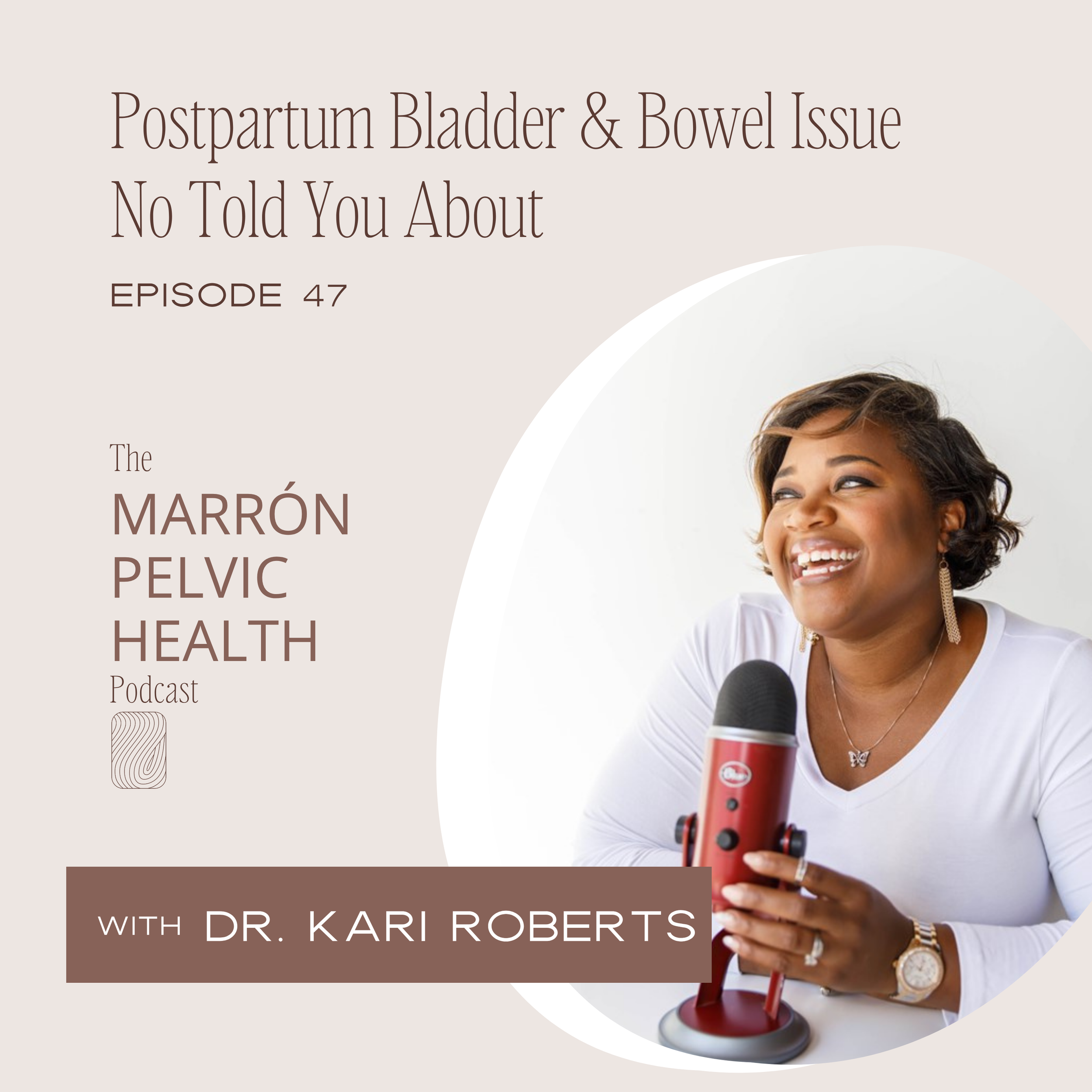
This episode of the Marrón Pelvic Health Podcast, hosted by Dr. Kari Roberts, discusses the postpartum bladder and bowel issues that many women experience after childbirth but are rarely prepared for. From urinary leakage and urgency to constipation and difficulty controlling bowel movements, these symptoms are more common than most people realize and can significantly impact daily life and confidence. Dr. Roberts explains how pregnancy, delivery, and postpartum recovery can affect the pelvic floor and contribute to these concerns. The podcast emphasizes that these symptoms are not something women simply have to “live with,” and that pelvic physical therapy can play an important role in restoring function, improving control, and supporting recovery after birth. Awareness, education, and proper treatment are key to helping postpartum women heal confidently and comfortably.
Book a call with Dr. Kari Roberts today.
-
Dr. Kari: Are you pregnant and ever thought, why didn't anyone tell me about that?
If so, stay tuned to this episode because we're going to get all into bowel and bladder habits that happen during pregnancy that someone may not have told you about.
Dr. Kari: Welcome to the Marone Pelvic Health Podcast. Hi, I'm your host, Dr. Carrie Roberts. On this show, we will be discussing a variety of things regarding your pelvic health.
These conversations will be a mix of education,
personal experiences, and a blend of tips you can apply to have a healthier pelvis. The goal of this show is to normalize conversations around pelvic health and help women stop suffering in silence.
Dr. Kari: And today we're talking all about bowel and bladder changes that can happen while you're pregnant. While someone is pregnant.
So let's just jump right into it. I've got my little notes here. So in case you see me looking down.
What are some bowel bladder changes that usually can happen while someone is pregnant? The first one is urinary urgency. So urgency is that urge or that sensation that you feel that you have to pee.
When we're talking about urinary urgency, there is a bowel urgency means the same thing, just the urgency when you feel like you have to ****. So, so the urge that you feel that you have to empty your bladder or void or pee,
that can increase.
You can also have an increase of frequency, that can increase. So the number of times that you have to void can increase.
Something else that it can increase when you have a little bit of leakage. We call that urinary incontinence. That can also happen while you're pregnant. If you want to know all about urinary incontinence,
check out my episode, episode 46, where I get into what that's all about when someone is pregnant.
Getting back to this, other things that can happen or changes that can happen while you're pregnant,
you can have bowel or gas incontinence. So fecal or gas incontinence, which basically is when you lose your. Well, like past gas fart, you,
you know, we all know what it is. We have all done it before. When you do that, not on purpose.
That is a form of bowel incontinence because we should always be able to control the gas and control the fecal matter from our ******. And when you can't control that like we want to, that's a form of bowel incontinence and the opposite.
So constipation that I have so many patients that come to see me while they're pregnant and they're like, I didn't know I was going to get constipated or what can I do during that?
Now that I'm constipated while I'm pregnant, is it normal? So,
a short version, none of these things are typically normal per se, but they are very common. And there are things that we can definitely manage through at home, things, maybe even seeking out medical help.
But before we get into the help section of this conversation, let's talk about the why.
Why does your bowel and bladder urgency and frequency and control change while you're pregnant? Well, put simply, those muscles are put on stretch. As you're growing your baby,
your, those muscles are stretching out, the load is increasing. You've got a baby, you've got you, you're gaining weight, the baby's getting bigger. All of that stuff puts extra load on those muscles and those muscles are stretching out.
So as muscles stretch out, they may not work as efficiently. They might lose their coordination.
That could be a really big cause.
Something else that we can see happening is sometimes you can develop some nerve irritation or some nerve damage while you're going through pregnancy.
And nerves help control the function of muscles. So if you've got a nerve irritation, that can impact how well those muscles work.
Of course, we can't forget, I think I say this in every episode, our dear old friends, the hormones, our hormones can fluctuate. As hormones fluctuate, that alters the quality of control that muscles have.
It also alters the flexibility,
how well the muscle is able to move and how well it's able to contract.
The that is definitely impacted by the hormones.
Then we have different forms of trauma can impact the bowel and bladder control.
So when we're thinking of trauma during pregnancy, pregnancy,
as normal as it is and as controlled as it is, controlled trauma is still trauma.
So the vaginal birth of a baby can result in some trauma to the pelvic floor or other body parts like the hips and the low back. You can also have other trauma that we might generally think of, which is an episiotomy or some sort of tearing,
also C sections. That is another form of controlled trauma.
And then something else that can happen while you're pregnant is that core. The core system, the abdominal system can change, it can lose its pressure. Management characteristics can change.
And as the pressure changes, that can impact how other muscles we work and that can result in bowel or bladder changes.
Let's shift over a little bit and focus for bowels, just For a moment, our bowel function.
So certain things can cause changes in our bowel habits, which could lead to increased frequency or really constipation, because constipation is really common during pregnancy.
So one is the fear of pain.
We,
there are a lot of people that have had fear of pain as child, as children,
or fear of people smelling your bowels or fear of being in public and all of that stuff that can definitely contribute to constipation.
And if you're on any sort of medication, especially postpartum, if maybe you're on some opioids or some pain medication that can slow down the function of the bowel movements, which can, which can lend itself to constipation.
If you're dehydrated, maybe your demand for hydration has increased and you haven't increased how much you're taking in.
This is also something I see when people are breastfeeding because they do need to hydrate so much. If they're not getting enough in, then they're relatively dehydrated, which can contribute to constipation.
And if you just have poor toileting habits, if you're used to bearing down, if you're used to not sitting properly, if you're used to rushing or maybe the opposite, you're used to sitting on the commode for 5, 10, 15 minutes, then those that can also contribute to the constipation.
Now,
when should you worry? When should you be like, you know what, I'm gonna maybe look into a little help? Well, if you've got ongoing leakage, which I talked about in the last episode, if you want more details, check out episode 46.
But also if you've got pain with your bowel movements, if you're feeling a heaviness down in the pelvic area, or if you're having to actually splint or use a finger or external pressure to get the bowel movement out, then those are all signs that you might need to seek professional help to manage your changes in your bowel and bladder habits.
Now, what can be done? Of course, if you've got any sort of medical thing, you can always seek out a medical professional, Seek out your physician, follow up with your ob, follow up with your primary care physician to see what's going on medically.
But then also from a physical perspective, of course you can definitely check out a pelvic physical therapist. And in pelvic physical therapy, we really optimize the intra abdominal pressure. We really talk a lot about educating you with proper toilet hygiene and toilet habits we also can give.
You can also not necessarily us per se, but you could look into increasing your fiber, increasing your hydration, if that's something. And then something else that we're really great at is managing your scars.
So if you have scars from a C section, if you have scars from tear, if you have scars from an episiotomy, pelvic physical therapy is great to normalize that soft tissue mobility, which can also help improve the mobility of the muscles and help you with your bowel and bladder habits.
So I know this was another quick episode, but I hope this was helpful to let you know when you should worry, when you shouldn't worry, and if you need to seek out help, you are a little bit more knowledgeable as to who you should go to and the questions you should ask.
Thank you so much for hanging out for this episode and I will be back next week with another one.
Dr. Kari: Thank you for listening to this episode of the Marron Pelvic Health Podcast.
Please do me a favor and leave a review so that more people can find this content.
And make sure you like and subscribe yourself so you never miss another episode.
Your episode
00:00/08:34
Learn more aboutwhat to put here.
This episode of the Marrón Pelvic Health Podcast, hosted by Dr. Kari Roberts, discusses the postpartum bladder and bowel issues that many women experience after childbirth but are rarely prepared for. From urinary leakage and urgency to constipation and difficulty controlling bowel movements, these symptoms are more common than most people realize and can significantly impact daily life and confidence. Dr. Roberts explains how pregnancy, delivery, and postpartum recovery can affect the pelvic floor and contribute to these concerns. The podcast emphasizes that these symptoms are not something women simply have to “live with,” and that pelvic physical therapy can play an important role in restoring function, improving control, and supporting recovery after birth. Awareness, education, and proper treatment are key to helping postpartum women heal confidently and comfortably.
Check out Ep. 46 - Leaking During Pregnancy: What's Normal & What Isn't
Book a call with Dr. Kari Roberts today.
Apple Podcasts and Spotify only allow hyperlinks and (un)ordered lists.