Painful Sex Isn’t Normal: Causes & What Pelvic PT Can Do - Episode 34
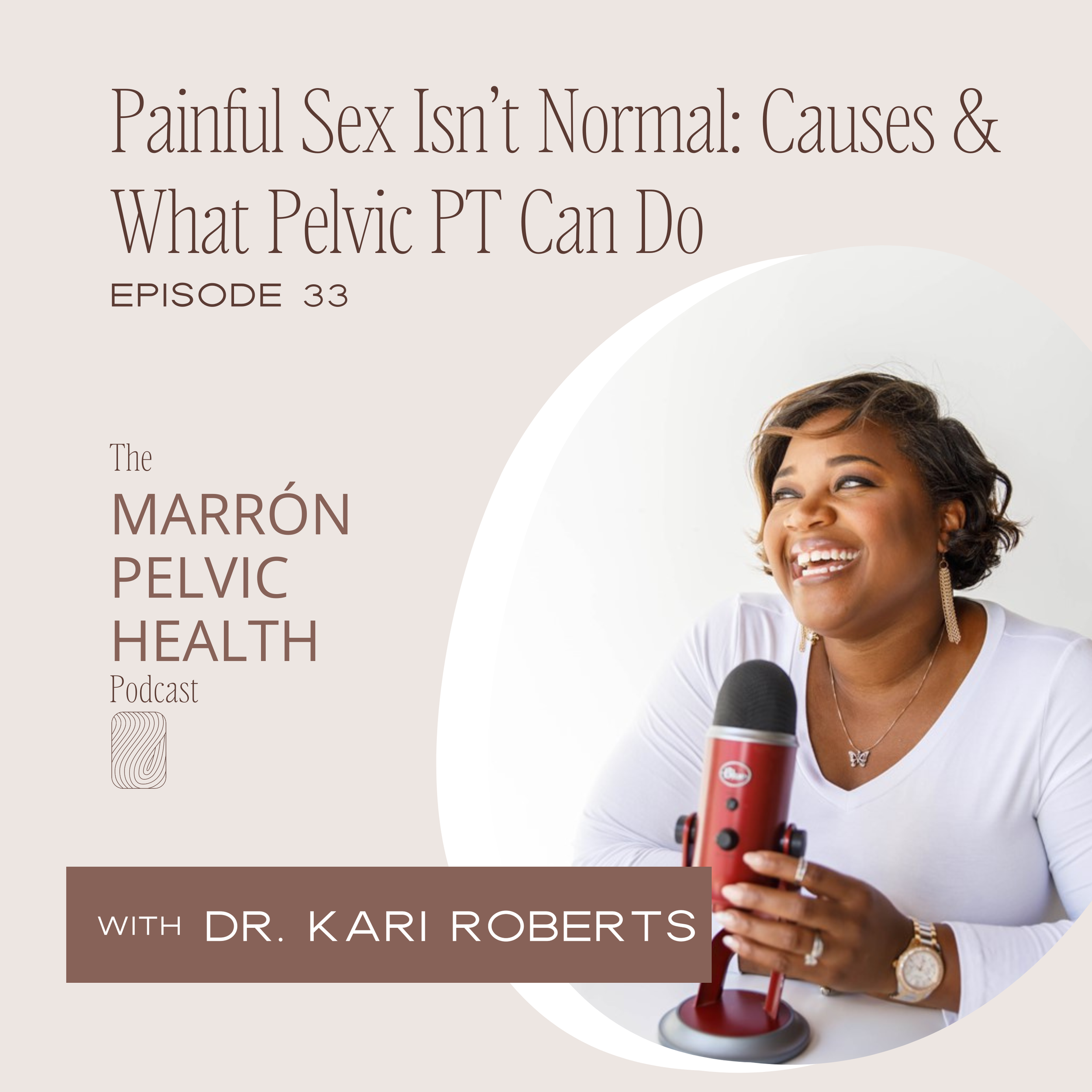
In this episode of the Marrón Pelvic Health Podcast, Dr. Kari Roberts delves into the misconception that painful intercourse is normal. She emphasizes that while common, it should not be accepted as part of healthy sexual activity. The discussion highlights various causes of pelvic pain, including muscle tension and hormonal imbalances, and presents pelvic physical therapy as an effective solution. By focusing on muscle coordination, blood flow, and scar tissue management, pelvic therapy can alleviate pain. Dr. Kari aims to empower women with knowledge to address their discomfort and enhance their sexual health.
Book a call with Dr. Kari Roberts today.
-
Dr. Kari: A little painless sex is normal, right?
Let's get into it and find out.
Welcome to the Marone Pelvic Health Podcast. Hi, I'm your host, Dr. Carrie Roberts. On this show, we will be discussing a variety of things regarding your pelvic health. These conversations will be a mix of education,
personal experiences, and a blend of tips you can apply to have a healthier pelvis.
The goal of this show is to normalize conversations around pelvic health and help women stop suffering in silence.
Today we're going to get into this question about painful sex. It's interesting because many of my patients come to me not for painful sex, but they end up having painful sex and they don't say anything about it because they've been conditioned to think that it's normal.
And is it normal?
Is it normal to have discomfort when you're having intercourse?
I'm primarily speaking to women.
Most of my patients are women.
Some of this does apply to men. Don't come for me in the comments.
But for all intents and purposes, we're going to be talking about female perspective with intercourse. We're going to be talking about vaginal penetration, ***** and ****** type intercourse. Okay,
so is it normal to have pain when you're having intercourse? The short answer is no. The long answer is everything that is common is not normal.
It is very common to have discomfort. It is very common to have pain with intercourse, but that is not normal. Think about something that happens all the time that's not normal.
Sometimes you drink water too fast and it goes down the wrong pipe, as they say. That's something that happens all the time, but it's not normal. It's common, but it's not normal.
Or if you think about something else, someone's laying down and they sit up really fast, they might get a little lightheaded or a little dizzy. That's a common thing when you sit up too fast, but it's not normal, right?
It's not supposed to happen.
There are certain situations where people enjoy inflicting pain with intercourse. We're not having that conversation.
Talking about when you have pelvic, vaginal vulvar discomfort, lower pelvic pain during penetration.
That's not normal.
That's not normal at all. My last couple of podcasts, I've come to you right off the top of the dome, as I say, but today I came with notes because I.
Because I want to make sure I arm you with really good tactile information.
And I just want you to be informed.
Now, just as A review. Let's talk about the pelvic floor. Let's do a little bit of anatomy refresher and see what is the pelvic floor and what is its function.
So the pelvic floor is a group of muscles and other tissues. But to keep it simple, we're gonna say a group of muscles in between your sits bones, your pubic bone in the front and your sacrum, your tailbone in the back, that diamond shaped area.
If you're sitting, you are literally sitting on your pelvic floor.
And those muscles are primarily,
primarily their job is to control your ping, you, your pooping and your sexual activity.
The interesting thing about the woman is the ******** is the only organ created for one job and one job only, which is climax,
orgasm, pleasure. Its only job is to make sure that you have pleasure.
So that is nestled within those pelvic floor muscles that we're going to get into a little bit further.
Now, just like any other part of our anatomy, when things are working perfectly or things are working well,
we don't have any issues.
When things aren't working well, that's when you can come into some issues. And the same is true with our pelvic floor. If the pelvic floor is a little hit or miss, then how it happens with our sexual activity may be a little hit or miss and our sensation might be a little hit or miss.
And the pleasure also might be a little hit or miss.
Now what are some causes of painful intercourse or what we're talking about today? Pain with penetration or also this can be true for anything that penetrates the ******.
So think about a speculum with a, with a, your annual pop.
Sorry, not pop, Pap smear, A gynecological exam, inserting a tampon, inserting a menstrual disc or cup,
inserting your finger or anything else for pleasure. Inserting toys,
inserting *****,
anything that's inserting the,
the ****** when we're talking about penetration can cause pain due to these symptoms. Okay. Or due to these causes, I should say.
So some of these causes could be muscle tension. The muscle is just super tight or those muscles are super tight and so there's friction with entrance.
If you've got any postpartum scarring, scarring in that area can create tension.
Scarring in that area can cause pain.
A lot of times that's postpartum. But you could have had sexual episode and you have scarring down there. You could have fallen off a bike. And there's all kinds of reasons why you can have scarring in your vaginal area.
Something else that can cause pain is emotional trauma.
If you've had some sort of emotional trauma, that can definitely cause you to have some emotional apprehension,
which can cause you to have pain with penetration,
Then you can have a shift in your hormones. As the hormones shift, the nutrients that go to those areas can also be altered. So when you're thinking hormone shifts, everybody thinks about menopause, but we can't forget about perimenopause.
We can't forget about postpartum timeframes. And we also can't forget about your birth control,
because birth control does alter your hormonal state,
which is the essence of how they work. So any four of those things can have impact on your hormones, which can have impact on vaginal penetration.
You can have other gynecological issues that will cause vaginal pain. Think about cysts,
fibroids, endometriosis, and just generalized pelvic pain.
You can have something else related to the bladder cause. Remember, the bladder is nestled right down there in the pelvic region. So. So think about bladder pain syndrome, which is a collection of symptoms.
They can't really figure out why these collection of symptoms are happening, but when you have enough of them, they clump them together and they say bladder pain syndrome. Or you can have something that's interstitial cystitis.
Now, interstitial cystitis and bladder pain syndrome kind of go together because they're finding a lot of people that are diagnosed with interstitial cystitis don't really have anything on the bladder, but they still have issues.
Right? And one of those issues can be pain with intercourse.
Something else that people are diagnosed with is vaginismus. Vaginismus is interesting because it is a muscular situation with those muscles being tight.
But there is a really large emotional, psychological component to that.
Then we can have dryness. If your body is not producing enough slip, enough fluid, enough lubrication, you can also have discomfort with penetration.
So those are some of the things. Those are some of the causes as to why you can have painful intercourse.
Now,
what can physical therapy do? What can pelvic PT do to help offset that? Well, when we're thinking about muscles, if they're too tense,
we can do lots of things to help relax the muscles,
lengthen the muscles, calm the muscles down.
Something else that can throw things off is the muscles may not be coordinated. They might be strong and have good restrictions, range of motion, but they may not be turning on and off like they're supposed to and if that's an issue, then pelvic physical therapy is perfect to get those muscles recalibrated re coordinated.
Something else that happens is we can teach you a series of exercises and stretches and that can increase blood flow. That can also increase flexibility of those muscles, but increasing blood flow.
When you think blood flow, think about you need really good blood flow to reach climax. That ******** needs good blood flow. And we need good blood flow for our lubrication.
So blood flow is important with that.
Also,
the ****** lengthens when we are sexually aroused, and blood flow allows that to happen.
So getting the right exercises, the right stretches, the right movements, the right strengthening things can be very beneficial to increase blood flow. And that increased blood flow can help you with reducing that that vaginal pain.
Something else that pelvic physical therapy is great for is scars.
We can help those scars remodel. We can do soft tissue techniques. We can use tools. We can use needling if needed needed. There's all kinds of things that we can do to help the scar remodel.
So that's no longer an issue.
And then also we can help your body as a whole,
help you learn how to reset, recalibrate your nervous system.
A lot of times we can be in a stressful situation.
We can get used to our body being in a stressful situation. But sometimes we need to do some treatments and exercises and conversations about calming down or resetting that neurological system.
In the physical therapy world, we call that neuromuscular re education.
So NMR is something that all pelvic floor physical therapists do. We're really good at that.
And we also give you lots of of education.
So we can educate you on different positions so that the intercourse is not so painful. We can educate you on how to properly hydrate. So that's going to help you with your lubrication and your blood flow.
We also give you lots of information on tools. There are tools designed to reduce pain. There are tools designed to help you control how deep the penetration is. There are other tools like dilators that help your tissues get used to that pressure so that they can relax and things can go in and out.
Not so much stretching as much as dilators, really get those tissues used to that, that good comfortable pressure.
And a side note of reducing the muscular tension, improving your muscular coordination, improving your scar mobilization,
giving you lots of education,
arming you with the tools and helping that neurological system reset with the neuromuscular reeducation. Those are all of the things that we can help you with. Directly. But the IND benefit of that a lot of times is confidence.
So when you think about some of those things, like you might have had physical trauma, or you might have a psychological or an emotional impact that's causing the pelvic pain or is a part of the pelvic pain.
We are not psychotherapists, right? We, we are not. That's not our wheelhouse. However,
improving your physical function, improving your physical well being can help improve your confidence. And I would argue that improving your confidence, arming you with knowing what to do and what not to do and what makes your body tick and what doesn't make your body tick can help you feel better and does have an emotional or a psychological side effect of that.
Now, what if you come back and say, carrie, I went to the doctor,
the doctor said everything's fine.
The doctor said everything's normal, or this is one that I love. You go for your 6 week checkup after you've had a baby and the doctor says, check, check, check, everything's good.
Go off and be great. You don't have any more restrictions. And you're like,
I'm scared. I haven't had anything come in there in a while. Or the last time something came out of there, it was a little weird, it was a little traumatic, or it was my first time.
If it's your first birth, all of those things can play into that. Or if you think about someone that's had interstitial cystitis or bladder pain syndrome and they've done the imaging, they've done the blood work,
they've done all of the scans and they say, look, everything's fine.
We don't see a reason for you to have pain. We don't, we don't see that.
So we don't, you know, everything's fine. And you know that everything's not fine because it doesn't feel fine.
First,
as someone that has had chronic pelvic pain in the past, I will tell you you are not alone.
It's totally common for a doctor to tell you everything is normal and you still not feel normal. I, I like to think of it as medical doctors. They're thinking about medicine, they're thinking about organ systems and organ functions.
And that is a great thing. When you get all of that testing done and they check everything and say everything's fine,
I say that is a good thing because now we know we need to look at something that they don't look at and something that physical therapists are specialists in that medical doctors aren't Specialists in are joint mobility and muscle function.
So that's something that we can really focus on here. In pelvic physical therapy, we're going to look at the, the health and the function of your muscles. Just think, when you go for a gynecological exam, the doctor literally blows through all three layers of those muscles and looks straight for the cervix.
We're checking to see if you have any other cancers or anything that, any abnormal growths and things like that, which is what we need. But, but if all of that's normal, let's take a step back and let's see.
Okay, let's see what's going on with these muscles. That's something that is often overlooked.
Pelvic physical therapy is great at bridging the gap because if you've got, let's say you, you're dealing with a therapist and you're trying to get your psychological, your mental state cleared up, but those muscles are still very tight, or everything is getting cleared from a mental perspective, but you haven't had penetrative sex or,
or you're scared or you're uncomfortable,
then pelvic physical therapy can be a really good bridge with the education that we provide,
with the safe space that we provide with the tools that we can educate you on. And I think the pelvic physical therapy can really bridge the gap. When your physician is saying everything's fine, we want everything to be fine medically, but also we want those muscles to be able to function at their optimal level.
I wanna share a quick success story with you.
Was a patient that I've had that had, without getting into too much detail,
she had a sexual encounter that left her with some vaginal and vulval scarring.
And medically she was getting treated for that and things were getting better. But physically she just could not have anything enter or exit her ****** without any sort of pain.
So after several months of working together, she was able to resume being intimate with her partner.
She was actually holding herself back. She had a very strong emotional falling out with the scarring and things that she dealt with. So she was able,
with us working together,
she was able to find a psychotherapist to help her on the mental side. And then I worked with her on the physical side. And after a few short months, she was back able to be intimate with her partner.
She was able to start new work. She was able to get back to the things that she enjoyed because she was not being kind of held hostage with her pelvic pain.
Even something as simple as how she manages her hygiene. During her menstrual cycle,
she wasn't able to use tampons. She wasn't able to use reusable tools like cup or a disc because of the pain. And when we were able to get the pain under control, she was able to feel comfortable out on the town with her friends, with her partner, not having to worry about what things happen.
When she has her cycle, she was able to resume intimacy with her partner, again with pain, and she was able to have intimacy with her partner in a variety of positions because those are all things that we were able to work through through physical therapy.
So I just wanted to share that success story. If you're dealing with something like that, you're not alone. There are definitely options for you. You might have to do a little digging, which is why I made this podcast.
If you're in the Atlanta area and you want to see if we can work together, or if you're virtual and you want to see if we can still work together, definitely hit me up.
The details are in the show notes and if you know of someone that's dealing with this or it comes up in conversation,
let's just try to normalize. Let's try to level the playing field and let our friends and family know. It is not normal to have pain with intercourse. It's not normal after you've given birth, it's not normal after your cycle, it's not normal during,
during menopause, it's not normal after surgery. All of those things, it's not normal. It is common, but it's not normal. And since it is common, there are things that people can do.
So that's why I wanted to come to you with your in your earbuds today and I'll be back in your ear next week with another episode.
Thank you for listening to this episode of the Marron Pelvic Health Podcast.
Please do me a favor and leave a review so that more people can find this content.
And make sure you like and subscribe yourself so you never miss another episode.